Image Map

Sunday, April 26, 2015

What We've Been Up To!

Small feedback group.
We've been busy these past few weeks!  In writing we're been working on feedback and revision.  The kids are giving feedback whole class, small group, and one on one.  We try to revise (whole group) one piece a week. I make copies of the piece.  We highlight parts we really enjoy.  We attach a feedback form where we evaluate whether the piece has all the parts, something we enjoy, and then a place where we can ask questions, or give a suggestion.  Then the author sorts the feedback.  If a few people say it could use, for example, adjectives, then we pull a small group adjective group to see where the featured author could place adjectives in the piece.  The feedback group then brainstorms with the author.  As of now, I'm running these groups.  I haven't released them, but I am seriously amazed at how great the feedback is that the kids are getting.  And I'm so impressed with how the authors view the feedback.  They love it! GO GROWTH MINDSET!

We've also been working on text features and actually assembling informative articles.  I also made QR code scavenger hunts that the groups use iPads to search for text features.
In math we've continued with the fun of scavenger hunts by searching for plain and solid shapes around the room. We've also been focusing on different types of comparison math problems. 
In science we've had a lot of excitement, discovery, and learning working on our Waves:  Light and Sound Next Generation Science Unit where the kids have been learning about light and sound.  If interested in the product link it is below:  
I can't believe we only have a few months left!  
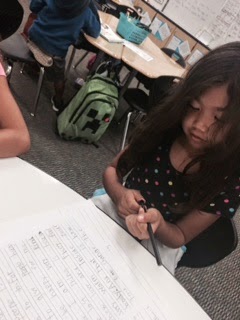
Students putting together articles.  Hard decision:  where to put the caption:). Also, getting ready to find headings using a QR Code!

Look!  We found a triangle.
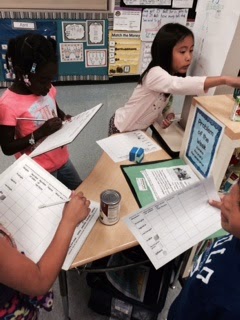
Shape scavenger hunt.
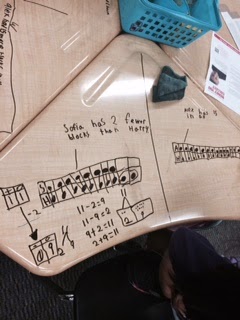
Student work on a comparison problem.


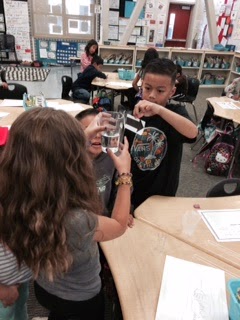
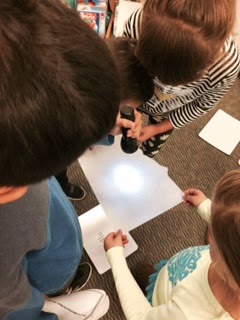
Watching refraction!


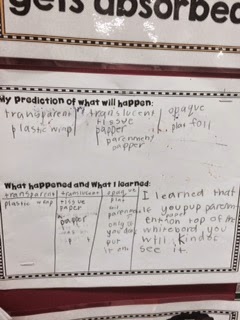
Transparent?  Translucent?  Opaque?

Part of our science wall.  Vocabulary cards and ideas are in my TPT unit.

Military appreciation week.  One of our amazing dad's, who is a Military doctor, brought us all stethoscopes.  Great for our sound unit!  So grateful!

Designing and building communication devices.

Scientists predict and observe!

Science doodle vocabulary!

Project Based Learning...by accident

It all started when a couple of my students read a book where some owl students put on a spring festival for their school.  They immediately raced to me with the book in hand, and asked if they too could put on this fabulous festival.  With only a few weeks before spring break and spring conferences (which means a large battery of assessments), I knew it would be a challenge, but those big eyes, mile a minute words filled with excitement and ideas, and sweet little smiles one me over...in a flash.
  
So, we agreed to a class spring festival and it began.  The three students brainstormed ideas of activities that they would like to do and we negotiated the activities and settled on a set number.  I agreed to give them the Friday before spring break.  They decided on the following: 
1)  They would write a spring article using text features we'd been studying.
2)  They would make a scavenger hunt for outside on the playground.
3)  They would design a noun guessing game with spring nouns.
4)  They would pick 3 art projects to make off Pinterest.
5)  They would author a Kahoot it! question game with questions based off the article.  

This is one of the to do lists.

These are the art projects the 3 girls chose off Pinterest.

A stage in the development of the festival.  Lists and lists and lists! Edited articles.


Students created a noun game where students gave clues on their spring noun and their partners guessed the spring noun.


It was a GREAT experience.  The students have always had a block of Daily 5 time that they could learn what interested them in the context of reading and writing, but these three students took it to another level.  They were so motivated and the bulk of what they were doing was all literacy related.  The learning extended beyond what I would have expected.  They had to be organized, accepting of feedback, and they truly had to focus on time management, all in first grade!  As a teacher, I let go of total control and instead guided their learning.  Did I provide them some structure? Absolutely.  Did they take ownership of their learning.  Yes, they did.  
Reflecting, if I had a whole class creating spring festivals I would need to provide a lot more structure and guidance, but it inspired me to create a project forum for our next unit.  I'm so excited and I can't wait to see where the adventure will take us!

Monday, March 30, 2015

Place Value - Builiding a strong sense of numbers

 The last couple of years I've taken a different approach to teaching number sense.  I've really based it on having the kids make a ten.  Although I've always taught it as a strategy, I focused on it as the center of my math instruction, and it has completely improved the number sense that my students have.

Before, I always felt that some kids just naturally make a ten in their mind, and some will come to it later.  I exposed the kids to the strategy, but it was just that, a strategy.  However, after really looking at Engage New York (Eureka) and the Common Core Standards and Mathematical Practices I focused my instruction on the concept of making a ten.  

I taught it as a story, telling the kids that all numbers want to be a 10 or a multiple of 10.  They need a BFF to do so, and we started learning our facts to 10 as pairs of best friends.  Then the numbers made a happy ten.  This made them laugh and made them learn it. 


As the numbers grew larger and we discovered place value with tens and ones, I was even more sold on the strategy.  The kids were adding and subtracting numbers with ease using the simple make a ten strategy.  They transferred it right on to multiples of ten.  It was awesome to see. 

Even though it was hard for some to grasp at first, I stuck with it and now I can confidently say that all my kids can make a ten!

If you are interested in any units, I have a few below.  I teach math using Power Points.  They keep me moving forward even though we move from desks, to carpet,  to games, etc.  They are organized around the Common Core Standards and the Mathematical Practices.

https://www.teacherspayteachers.com/Product/Place-Value-Power-Points-1783218 


https://www.teacherspayteachers.com/Product/Making-a-10-using-friendly-numbers-1498421

Warmly,
Valerie


 A student about playing "Represent" from my place value unit.


Wednesday, February 25, 2015

New Units

I've got a couple of new products this week (see links below)!  I'm also always updating products as I teach and reteach in my own room so my products are "living documents".  When you buy them I will always offer the updates for free! 
New Products:
 https://www.teacherspayteachers.com/Product/Community-Helpers-Close-Reading-and-Writing-Unit-Common-Core-1725108
https://www.teacherspayteachers.com/Product/Moving-Day-Common-Core-Unit-1725595

Monday, February 9, 2015

Another week of fun and learning . . .

So I started out wanting to make silhouettes with my students with my students to go with this beautiful writing that they did about what is the one best thing that they could do to change the world (inspired by our study of Martin Luther King Jr.).  Since overheads are no more at our school (and that is the way I've always done it), I did some investigating and decided to try to use photos and PowerPoint. Here's the steps:
1)  Take photo (I had a parent help and we used a smart phone).
2)  Email photo to computer.
3)  Drag photo into Power Point and then double click on center.  Then hit recolor.  From there you can get creative. Originally, I was just going to recolor all black, like a silhouette, but they looked so cool like this that I just left them as is.  Check out their cuteness!


We've also been very busy with trying to explain in math using mathematical practices.  Kids are getting great at using structure, precision, and beginning to use discourse more to understand their classmates' work.  We are blessed with these write on desks, so after they do their problem, they give feedback.  If they do not understand something or if they like the thinking they can talk to the person or write down their questions/thoughts.  They also have been using dimes and pennies to express tens and ones.  It's so important that these little guys see coins! They rarely get a chance to see them anymore.


On the above video one of my students is using the retell chart and I was SO happy that she used the vocabulary we've been working on!  The retell chart is great for teaching vocabulary, story elements, and of course retell and summary.  Other photos are all from our work with Happy Birthday Moon this week.  The kids are loving the unit and finding evidence, retelling, and rereading our little book.  The character trait to the right made me laugh so hard!  If interested in the unit see my TPT store or the link below:
https://www.teacherspayteachers.com/Product/Happy-Birthday-Moon-Common-Core-Reading-and-Writing-Unit-1668717


And my favorite part of the day:  Gratitude!  Above are some adorable gratitude statements from the end of the day.

  
Warmly,
Valerie


Sunday, January 25, 2015

A week in the life of our class...

Showing earth's revolution and rotation in first grade
 We've had a couple of busy weeks!  Here are some pics of some of the fun we've had learning.  I've also attached a sample lesson plans so that you can see how it all fits.  I love the Discover about rotation and revolution with the TPR activity to the right.  Earth's Place in the Universe is one of the first Next Generation Science Units we've worked on this year and we are still going strong.  The kids love learning about why we have day and night and  seasons.  Below is a link for the unit...
https://www.teacherspayteachers.com/Product/Earths-Place-in-the-Universe-Patterns-in-the-earth-moon-sun-and-stars-1618782


We've also been revisiting favorite stories and discussing central message, one of our CCSS Reading Literature Standards and an important concept for kids to start thinking about.  We noticed how many books have multiple messages!  Great conversation starters.
central message in first grade


 narrative input chart for Happy Birthday Moon


 We also started our literature study of Happy Birthday Moon.  We are connecting this with our study of earth, moon, and space patterns.  This is a retell chart that is located in the unit. I use this chart to retell the story with the kids, highlight story elements, and focus on vocabulary.  It is also great as we read through and choral read the story.

https://www.teacherspayteachers.com/Product/Happy-Birthday-Moon-Common-Core-Reading-and-Writing-Unit-1668717
graphing in first grade
 We are finishing up our measurement unit. Our class is using Engage New York/Eureka.  We had a blast with a Christmas Measurement unit before break and then we focused on graphing data.  The kids had a fantastic time surveying classmates and creating data information packets with graphs and questions.  I broke it down super simply for them so that they could feel successful and they LOVED it! (I'm getting it ready for a unit that's not quite ready...)
math wall first grade


Our math wall is to the right and below.  I'm blessed with a lovely room!


graphing and data anchor charts first grade

Earth's place in the universe craftivity


The picture to the right shows our orbits that we made with brads and the masters from the Earth's Place in the Universe unit.  We had a blast!


Finally, below are the lesson plans that went with these activities and more.  I'm offering them as a freebie on TPT. The link is below.
lesson plan freebie


https://www.teacherspayteachers.com/Product/FREEBIE-Weekly-first-grade-lesson-plans-1670975

Warmly,
Valerie

Tuesday, December 30, 2014

Building Fluency

Reading has so many components and so many factors.  After 20 years of teaching kids how to read, they continually surprise me, and they also follow some predictable patterns, which comfort me. Each child seems to attack reading differently, whether they favor whole word reading, phonetic reading, or a mixture of the two.  My own two kids at home, were perfect examples of different reading styles.  Both my kids loved to listen to stories and we would spend hours curled up reading in the mornings, naptimes, and evenings.  My daughter, memorized books very early on and focused keenly on words as I read them to her in story books.  My son, contrastingly, focused on details in pictures and imagery in his own mind.  We all were great at thinking aloud, as I modeled this from day one (perk of taking all those education classes and the 7 years of shared reading I did with students before I was blessed with my own loves).  We wondered about characters, imagined them in different situations, and read all the books by our favorite authors to compare the writing, the characters, illustrations, and messages.  This, to me, was stage one in their reading development.  My excitement spilled over to them.  I viewed it as fun, so in turn, they did too.  To me, this is an important part fluency building and an essential part of teaching. 

Once they started reading on their own I figured out that they had different attack skills that they favored.  My daughter, a whole word reader, saw a word once and photographically knew it.  But, when faced, with an unknown word, needed help to decode it.  That's when I started breaking down the phonics rules for her. She didn't love how it slowed her down a bit, but once she had enough practice with them, it was all automatic and she could read anything.  My son, on the other hand, attacked things in part, phonetically.  He needed a lot of work memorizing sight words (as a whole).  We wrote sight words with shaving cream, created elaborate matchbox car roads that had sight words at each turn that he had to read before his car could pass, and played a variety of games to cement the sight words for him.  He needed a lot of repetition and he needed the phonics to crack the reading code.  Once you figure out a student's unique pathway then you can help them access reading. That is the beauty of teaching.

What all kids need, though, is practice.  Some devour books and practice is natural because it is something they love to do. Some need it to be more game based and center like.  Most need a combination.  What has worked best for me in teaching reading is a balanced, blended program.  Essential is reading aloud, thinking aloud, students talking verbalizing and synthesizing their comprehension (partner reading, literature circles, discussion roundtables, etc...), strong, explicit phonics instruction through the context of reading, sight word automaticity, and fluency practice.  One of the best tools that have worked for ALL my students (even those with the most challenges) is phrasing.  Even 6 years olds don't want to be held back on what they read.  They often grab books that are too hard for them, but don't let go at library time or free choice reading of that one special book because they love it.  Phrasing is a way of letting all kids have access to core material like articles and close reading passages because it offers practice in small chunks, scaffolding the core for all.  I usually use phrasing for my "lovable" readers as a preteaching tool in small group the week before we start a new close read so that they have a leg up and can access the reading.  This gives them confidence, and the bonus is most of the words are sight words so they are gaining valuable practice with automaticity. 

I decided to take it a step further and make this phrasing activity a center after I work with the kids in small group, and it has worked out great.  I'm in the process of "beautifying" these units to put on TPT and I have just finished my first one.  It focuses on informational text and is centered around arctic animals.  Below is a link if you are interested.  I'll be coming out with a lot more soon.  Also linked below is a sight word center using ladder writing which is great for those kids who need to connect the reading memorization of the word with writing.

Warmly,
Valerie
http://www.teacherspayteachers.com/Product/Fluency-Center-Arctic-Animals-1620448


http://www.teacherspayteachers.com/Product/Sight-Word-Writing-Center-1597770